The World Broadband Association (WBBA) is a multilateral, industry-led association, providing leadership for digital broadband innovation across the next decade.
Our objective is to overcome industry challenges and drive the provision of networks and services for all. We aim to accelerate the healthy development of the global telecom industry, creating sustainable benefits for stakeholders, end users, and society.
The WBBA is an independent legal entity registered in Switzerland.
Our Vision
We envision a world where everyone has access to high-speed, reliable and affordable connectivity. The WBBA provides an open, multilateral platform for industry cooperation and partnership. Through collaboration with standards and policy organizations, we champion benefits that converged networks and cloud infrastructure can bring.
Our Mission
The World Broadband Association (WBBA) bring AI, Cloud, and broadband industry leaders to pursue three common goals: Address global broadband industry challenges, create a collective voice, and shape the future of broadband innovation. We are dedicated to closing the digital divide and maximizing the social, environmental and economic benefits for all.
Addressing Industry Challenges
The WBBA was founded to address seven key broadband industry challenges. They are:
Addressing Inequality of Broadband Access
3B people – will be still unconnected by 2024
BB access speeds vary significantly by country, inequalities in infrastructure & service delivery
3B people – will be still unconnected by 2024
Developing Impactful Broadband Regulation and Policy
Regulators and policymakers can’t rely on market forces alone to deliver ubiquitous BB – new broadband investment models are needed
Regulatory complexity and diversity in different countries is hindering growth prospects
Ensuring Sustainable Service Provider ROI
BB RoIs for telecoms service providers are very low, rarely going above 1%
Next-gen PON FTTx to residential subscribers, SMBs, larger enterprises, and backhaul increase RoI
Demand-revenue-investment conundrum impacts RoIs
Enabling Vertical Industry Innovation
FBB ensures reliability, low jitter, and low latency – all key for industry vertical IoT transformation
Industrial IoT can deliver payback across a range of operational KPIs – and commonly relies on FBB connections
Broadband is a key enabler for driving enterprise digital transformation
Delivering End-to-End Experience
Broadband access reliability, coverage, and customer service matter as much as high-speed
Quality of experience (QoE) is becoming a key requirement
Building a Future-Proof Network
Networks must be ready to flex to support future services and business models
FTTH offers the best opportunity for supporting long-term evolution of future services – but presents some challenges
The road to future advanced digital services requires gigabit technologies, edge-cloud and network automation
Environmental Sustainability Challenge
Eco-friendly solutions are required to accommodate widescale broadband growth.
Bridging broadband access and ecological responsibility is vital for a sustainable industry future.
Basic connectivity is not enough. Unlike other utilities such as electricity, broadband has a quality element to it that dictates what and how that connection can be used.
Advanced cloud technology together with superior end-to-end connectivity can enable a wider and more sophisticated range of applications that can in turn drive greater innovation, efficiency, and wealth.
The demand from business for greater broadband service capability therefore continues unabated.
Both enterprises and broader industry ecosystems are actively looking at broadband’s role in enabling their digital transformation. Most respondents to the WBBA’s Thought Leadership Enterprise Survey stated that they need faster and more reliable internet to run their business applications.
All of the main types of broadband access technology have developed significantly over the years and are all now capable of delivering multiple 100s of megabits per second.
Certainly, in the short to medium term, xDSL, cable modem, fixed-wireless access (FWA), and satellite are all expected to have a role in the delivery of broadband services. However, full-fiber access will always deliver the optimum experience and remains the most sustainable and cost-efficient option.
Deploying new, full-fiber networks is an expensive business and the cost per premise connected can grow exponentially as projects move into more rural, harder-to-reach communities.
There is a danger therefore for governments to base their cost-benefit analysis on a national economic view. However, such analysis will miss all the social benefits, as well as the more local economic benefits, that advanced broadband networks can bring. Governments must take all benefits into account, including more localized ones, when creating national broadband policies.
Fiber optic technology is well known for its bandwidth capabilities, in both the downstream and upstream direction.
However, future applications will not only need ultra-high-speed services but also ultra-low latency and jitter, with high levels of reliability and consistency if they are to function properly. Countries with networks that are not capable of meeting such criteria will be left behind as the world moves to the next phase of internet applications such as the “metaverse.”
As well as delivering greater service experience, full-fiber networks can help countries move toward a more environmentally friendly world.
Fiber networks are significantly more environmentally friendly than equivalent copper-based networks, and can help support other green initiatives such as greater working from home, the use of advanced videoconferencing, etc. Fiber-based networks also require less maintenance due to there being less active equipment in the field, and can therefore reduce operators’ operational costs.
To fully exploit the potential of advanced broadband networks, the huge amount of address made available by IPv6 is needed.
With rollout of new access technologies like 5G and Fiber, IPv6 reached more than 30% penetration worldwide (APNIC) and is rapidly growing. IPv6 Enhanced technologies, including segment routing over IPv6, per flow monitoring and AI, enable a multitude of objects and people to be flexibly connected to the proper services, granting end-to-end quality of experience.
Today, the average fiber-to-the-premise (FTTP) coverage across the 81 countries covered in Omdia’s Fiber Development Index is 43%.
Based on the responses from the WBBA Thought Leadership Survey, respondents believed, on average, this coverage could be expanded to approximately 70% through private investment. It is clear that government support will be needed to get to 100%.
The cost of rollout is still seen as the number one barrier to fiber deployment.
However, a lack of data on the available infrastructure, access to key infrastructure such as ducts and in-building networks, and a lack of understanding both internally and externally are also key barriers to further investment.
Governments and other organizations can help service providers in numerous ways to encourage greater fiber investment beyond just financial incentives.
Respondents to the WBBA survey stated that a reduction in regulatory barriers, greater flexibility in partnership arrangements, copper switch-off regulations, and setting out minimum service standards for network installations, would all take priority over financial support.
Recommendations
All countries must look to maximize the potential of broadband. This means creating long-term national broadband plans that evolve around three basic phases of broadband adoption:
Phase 1: Fast deployment of basic connectivity (most likely focusing on wireless technologies)
Phase 2: Continued rollout of fixed-broadband access to 100% of premises
Phase 3: Continued investment in advanced broadband technologies to move to gigabit societies and beyond.
In order to help facilitate this evolution to advanced broadband networks, government organizations and regulators must consider:
Implementing regulatory flexibility, including the removal of outdated or non-essential regulation
Introducing flexibility in partnership arrangements; for example, allowing agreements between players, such as co-financing, collaborative models, public-private partnerships, etc.
Facilitating deployment through municipality approvals, using existing resources (government buildings, streetlights, ducts, etc.) and sharing infrastructure and facilities, including in-building networks. This should also include other types of utility infrastructure where possible
Providing financial assistance through investment support, incentives, and subsidies; e.g., universal service funds
Improving access to telecom facilities and physical infrastructure; improving procedures for rights of way and accessing public infrastructure, as well as broadband mapping.
Making the Recommendations a Reality
Operators, enterprises, vendors, regulators, and policy-makers should seek to create a collective voice, to evangelize, advocate, co-create, and partner in the drive toward the provision of ultra-broadband networks and services for all. Organizations such as the WBBA can help by influencing key stakeholders through discussion, education, and promotion. Specifically, the WBBA should aim to:
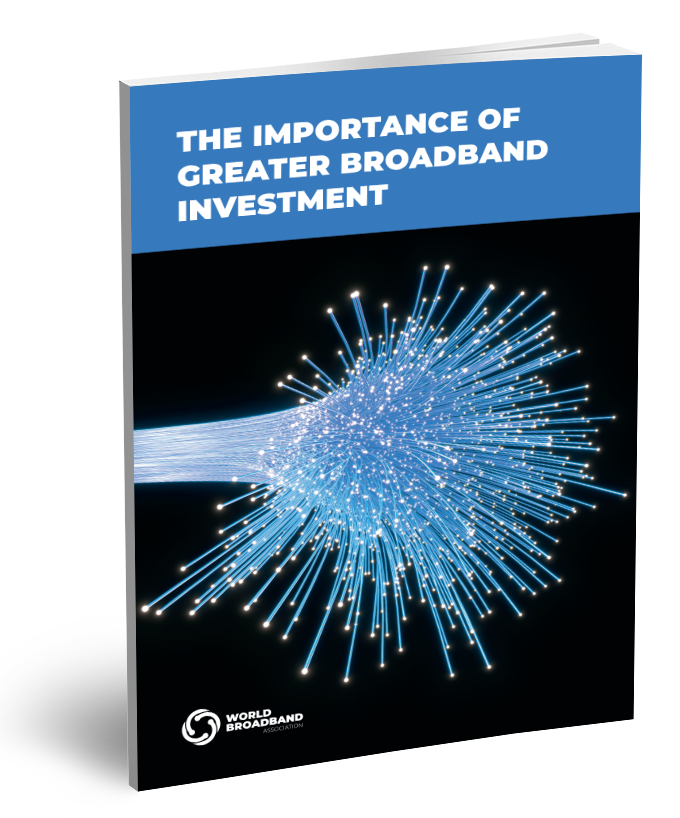
Set out the importance of greater broadband investment, not just for the good of the service provider but for countries as a whole
Promote regulatory, legislative, public relations agendas that help advance the interests of members through WBBA publications and live events, highlighting best-practice business models from around the world to remove any “lack of understanding at boardroom level”
Influence through research, discussion, and promotion of new potential marketing or naming concepts for fixed broadband to ease mass-market understanding of the different generations of broadband access – hiding technical jargon such as “Mbps,” “latency,” and “jitter” from the customer
Through thought leadership, media activity, and live events, continue to make the case for what governments need to recognize and do to close the industry innovation, socioeconomic, and environmental benefit gaps through infrastructure investment
Explore through new research the challenges and opportunities arising from changes in the industry structure, addressing its impact on the business and the standardization landscape. This includes aspects of fiber wholesale, the move toward horizontal industry structure with separation of infrastructure and services, and the change of customer relationship to digital
Work with stakeholder partners to understand and promote the potential of future applications that will bring new benefits to broadband customers and wider society
Develop in-depth thought-leadership research on the new revenue opportunities advanced networks can provide to service providers in both the consumer and enterprise markets
Develop and highlight best-practice investment models that show the true return on investment of a full-fiber rollout to both private companies and government organizations
Champion the needs of its members to highlight barriers to future investment, creating a platform to enable open discussion between different types of stakeholder to encourage greater cooperation and new partnerships.